Geotechnical Material Manufacturers


HDPE Spiral Rigid Permeable Pipe Drainage Pipe for Road and rail subgrades
Subclassification:
Drainage materials series
Key words:
Drainage materials series
Email:
WhatsApp:
Product Details
Spiral Rigid Permeable Pipe
Spiral rigid permeable pipe is a self-supporting subsurface drainage pipe wound from a profiled polymer strip into an open spiral structure. Because water can enter through the whole pipe wall instead of a few drilled holes, it collects seepage water far faster than perforated concrete or corrugated pipes, and conveys it away through a smooth, rigid bore.
- Spiral rigid permeable pipe for tunnels, roadbeds, slopes and retaining walls
- Open spiral wall draws in water along the entire pipe length
- Rigid self-supporting wall holds its shape under backfill load
- Lightweight lengths cut and joined on site without heavy machinery
- Resistant to weathering, chemicals and long-term burial
- OEM/ODM support for drainage and earthwork projects


How the Spiral Wound Design Works
- 1. Full-wall intake: the open profiled cells cover the full circumference, so groundwater is intercepted wherever it meets the pipe - not only at discrete perforations.
- 2. Self-supporting bore: the spiral winding produces a rigid ring structure that supports itself in the trench, keeping the drainage channel open under soil and traffic loads.
- 3. Fast conveyance: once inside, water travels through a smooth internal channel at high velocity, so smaller diameters or shorter runs can do the same job as larger perforated pipes.
- 4. Durable in ground: the polymer base withstands acids, alkalis and salts in ground water, and performs from freezing to high-temperature backfill conditions.
Product Parameter Table
Parameter | Unit | Reference Specification Range |
Product Name | / | Spiral rigid permeable pipe (subsurface drainage) |
Structure | / | Profiled strip wound into open spiral, self-supporting wall |
Material | / | Modified polymer (PVC/PE base, per project) |
Nominal diameter | mm | 50 - 300, other sizes on request |
Water intake | / | Open cells over the whole pipe wall; geotextile wrap optional |
Intake capacity | - | Water collection several times that of perforated pipes of similar size |
Flow performance | - | Higher conveyance than same-size concrete/corrugated pipes |
Jointing | / | Simple socket / insert connection, cuttable on site |
Temperature range | C | Service in buried conditions across normal climate extremes |
Chemical resistance | / | Resistant to ground water acids, alkalis and salts |
Colour | / | Black (custom on request) |
Length / packing | / | Standard lengths, bundled; project lengths produced to order |
OEM/ODM | / | Available - diameter, stiffness, opening ratio, colour, packing |
Origin | / | Shandong, China |
Typical Uses
- 1. Tunnels and underground works - drainage behind tunnel linings and around underground structures, collecting seepage before it builds pressure.
- 2. Road and rail subgrades - longitudinal underdrains below road and rail formations to lower the water table under the pavement.
- 3. Slopes and retaining walls - toe drains at slope bases and back-of-wall drainage that relieves hydrostatic pressure on retaining structures.
- 4. Basements and foundations - basement and foundation perimeter drainage routed to sumps or gravity outlets.
- 5. Sports fields and farmland - subsurface drainage for sports fields, golf courses and agricultural land.
Quality Control
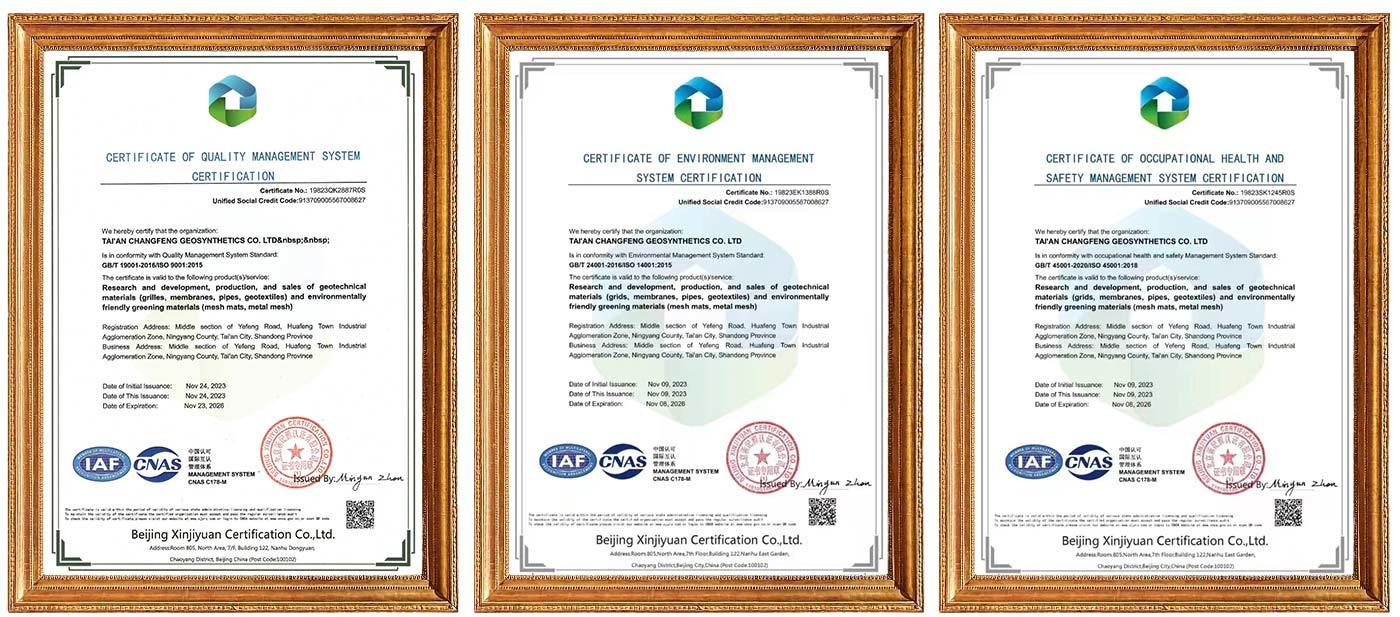
Each production run is checked from strip profile to finished pipe: incoming compound is verified, the winding line is watched for pitch and wall consistency, and sampled pipes are tested for dimensional accuracy, ring stiffness and wall integrity. Every length carries a traceable batch number, and inspection records plus third-party certificates (SGS / BV) are available for project submittals.
Packing and Delivery
Pipes are cut to standard lengths, bundled with end protection and matching shipping marks, then palletised or loaded loose; small diameters can be coiled to save container space. Loading plans with quantities and weights accompany every quotation. Orders ship within 7-14 days of deposit, FOB Qingdao as standard with CFR and CIF on request, and third-party pre-shipment inspection can be arranged.
FAQ
Q1: Why does it collect more water than perforated pipe?
A: Perforated pipes only take in water at drilled holes. The spiral wall exposes open cells over the entire circumference, so seepage is intercepted along every metre of the run instead of at isolated points.
Q2: Will the open cells fill up with soil?
A: In clean sand and gravel backfill the pipe is used unwrapped. Where fine soils are expected, a geotextile filter sleeve is supplied that passes water while screening out particles, keeping the cells open for the life of the drain.
Q3: How does it compare with concrete or corrugated drainage pipe?
A: For the same diameter it conveys water considerably faster, and it weighs a fraction of concrete pipe - so handling, trenching and installation costs all drop.
Q4: Can it be cut and joined on site?
Honor
MESSAGE
CONTACT US
Tel : +8617863869299
WhatsApp : +86-17863869299
Wechat : 17863869299
Email:wdf001@wdfgeomat.com
Address:Huafeng New Materials Industrial Park, Huafeng Town, Ningyang County, Shandong Province


GET A FREE QUOTE
Copyright : Taian Wandefu Polymer Composite Materials Co., Ltd. Seo Tags