Geotechnical Material Manufacturers

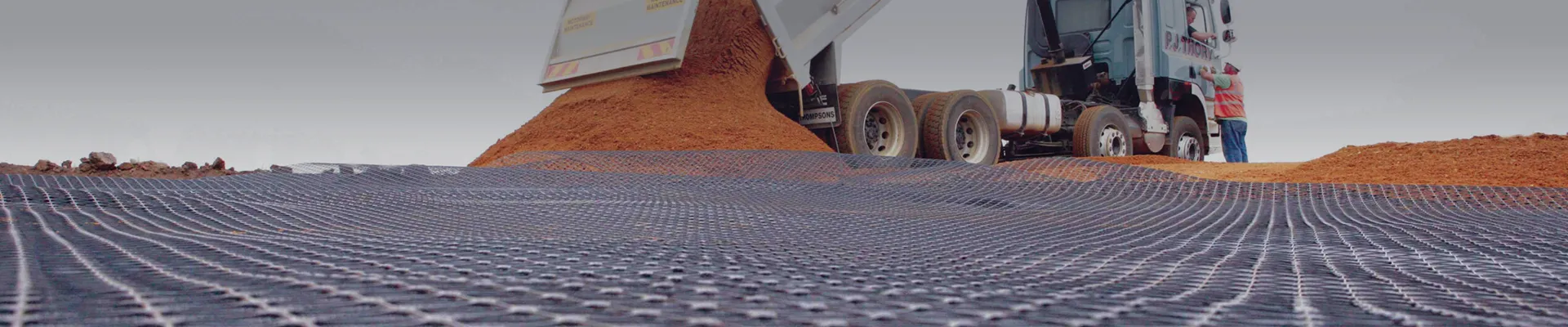

Polypropylene Needle-Punched Erosion Control Mat for Vegetated Slope Protection
Subclassification:
Erosion Protection
Key words:
Erosion Protection
Email:
WhatsApp:
Product Details

Heavy rain and concentrated runoff strip topsoil from slopes and channels faster than grass can grow back. Our erosion control mat solves this by armoring the soil surface from day one: a three-dimensional polypropylene matrix, needle-punched into an open weave, lies against the slope and holds seed, fertilizer and topsoil in place while vegetation establishes through it.
Once roots have grown through and interlocked with the mat, the mat and root system work together as a single reinforced layer that outperforms either component alone. The result is a self-repairing, fully vegetated surface with no hard armour to maintain - and no repeated re-seeding after every storm season.


How It Works
1. Hold - the open cells trap seed, fertilizer and water at the soil surface, protecting them from being washed away in the first critical weeks.
2. Protect - the mat shields bare soil from raindrop impact and shallow sheet flow while germination takes place, keeping sediment on the slope instead of in the drain.
3. Reinforce - as roots develop they weave through the matrix and anchor into the subsoil, creating a permanent, flexible vegetated reinforcement layer.
4. Sustain - the established root-mat composite resists flow velocities far higher than vegetation alone, and continues protecting for the life of the slope.
Technical Specifications
Property | Unit | Typical Value |
Material | - | UV-stabilised polypropylene fibre, needle-punched 3D structure |
Mass per unit area | g/m2 | 380-400 |
Tensile strength | kN/m | 3.5 |
Limiting shear stress - unvegetated | N/m2 | 180 |
Limiting shear stress - vegetated (6 months) | N/m2 | 510 |
Limiting velocity - unvegetated | m/s | 2.9 |
Limiting velocity - vegetated | m/s | 7.5 |
UV resistance | - | No tensile loss after 1,000 h accelerated exposure |
Biomass improvement | - | Up to +555% vs. untreated control at 21 days |
Standard rolls | m | 2.0 x 60 (120 m2) / 4.0 x 60 (240 m2) |
Colour | - | Black; other colours on request |
Hydraulic values from independent flume testing under 7-hour continuous flow, in both unvegetated and 6-month vegetated conditions.

● Channels and swales - irrigation channels, drainage ditches and grassed swales with concentrated flow.
● Road and rail slopes - cut and fill batters, embankments and retaining wall faces on highways and railways.
● Dam and flood works - spillways, dam crests and floodways subject to periodic high-velocity discharge.
● Waterways and wetlands - shorelines, wetlands and drainage outfalls needing a soft, vegetated edge.
● Mine and landfill rehabilitation - landfill caps, quarry restoration and revegetation of disturbed mining land.
● Landscape projects - parks, golf courses and civic landscaping where erosion and appearance both matter.

Installation in Five Steps
- Prepare: shape and compact the slope, spread topsoil, then broadcast seed and fertiliser as specified.
- Anchor the crest: excavate a 300 x 300 mm trench, roll the mat 150 mm into it, backfill and compact.
- Unroll downslope: keep the mat tight against the soil with no bridges, gaps or wrinkles.
- Fix: overlap rolls 100 mm shingle-style and pin through both overlaps with U-staples at about 1 m centres; tighten spacing on steep or high-flow sections.
- Finish: secure the toe in a second trench, water as required, and inspect after the first major rainfall.
Supply, Quality and Delivery
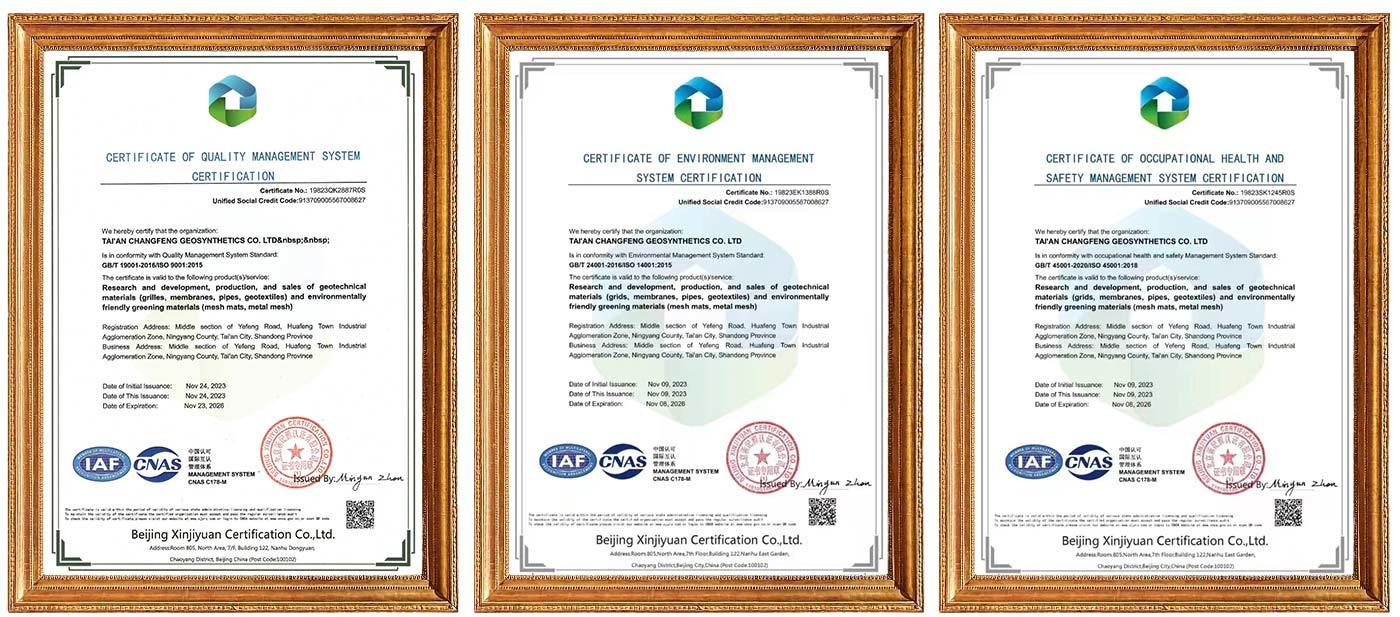
Every batch is produced under ISO 9001:2015 quality management and sampled for mass per unit area, tensile strength and UV stability, with results traceable to the production batch. Rolls are palletised, strapped and wrapped for export; container loading plans for 20GP and 40HQ are issued with each quotation. Standard orders ship within 7-14 days of deposit - FOB Qingdao as standard, CFR and CIF on request - and third-party inspection (SGS / BV) can be arranged before loading.
FAQ
Q1: How is this different from a jute or straw blanket?
A: Straw and jute blankets are temporary - they rot within one or two seasons. This mat is a permanent synthetic reinforcement that keeps working after vegetation establishes, so it suits channels and steep slopes where temporary blankets fail.
Q2: What happens in the weeks before grass grows?
A: The mat itself carries the load. It resists raindrop erosion and shallow flow immediately after installation, and the UV-stabilised fibre withstands at least 1,000 hours of sun exposure with no strength loss while vegetation closes in.
Q3: Which roll width should I choose?
A: 2.0 m rolls suit narrow channels and irregular batters; 4.0 m rolls halve the number of overlaps on wide slopes and cut installation time. Both are 60 m long.
Q4: Can it survive being buried under flood water?
A: Yes. Testing under 7-hour continuous flow recorded 2.9 m/s unvegetated and up to 7.5 m/s with established vegetation, with corresponding shear stresses of 180 to 510 N/m2.
Q5: Do you support projects, not just product supply?
A: Yes. We provide installation guidelines, batch test reports and loading plans with every shipment, and OEM/ODM support for custom roll sizes, colours and packaging.
Honor
MESSAGE
CONTACT US
Tel : +8617863869299
WhatsApp : +86-17863869299
Wechat : 17863869299
Email:wdf001@wdfgeomat.com
Address:Huafeng New Materials Industrial Park, Huafeng Town, Ningyang County, Shandong Province


GET A FREE QUOTE
Copyright : Taian Wandefu Polymer Composite Materials Co., Ltd. Seo Tags